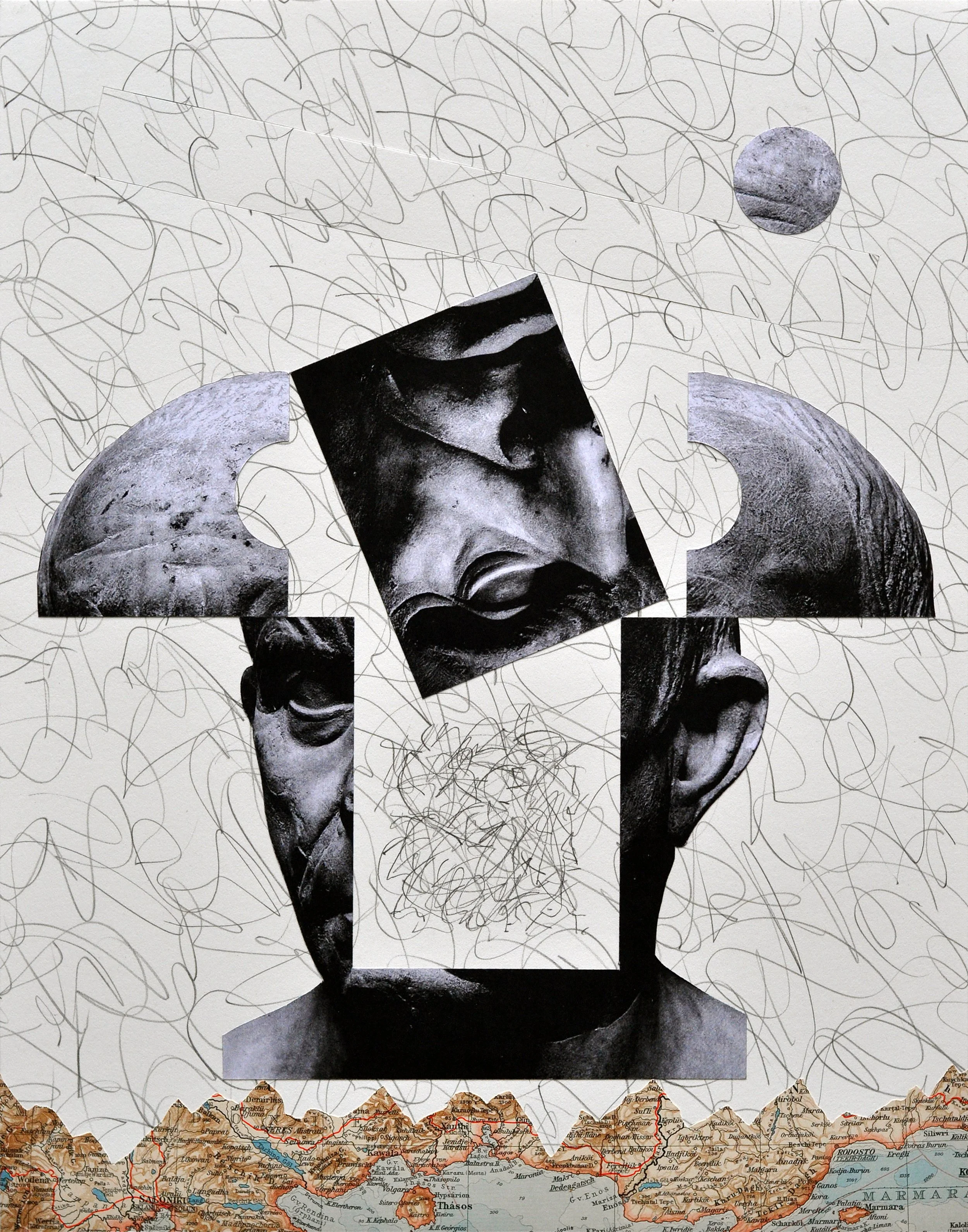
Andrew Ginzel, “Crux,” 2020, Ink, polymer toner, graphite, on paper on wood panel,
H. 14 x W. 11 inches (H. 36 x W. 28 cm) Image courtesy of the artist

Jaqueline Cedar, “Body Back,” 2021, acrylic on canvas, 12 x 9 inches. Image courtesy the artist
Escape: 100 Years after Houdini
a group exhibition featuring works by:
Caetlynn Booth, Jaqueline Cedar, Andrew Ginzel, Aaron Krach, Kerry Law, Ellen Letcher, Santiago Lizzantino, and Wo Xinyu
November 8 – December 13, 2026
Opening Reception: Sunday, November 8, 4-6pm
Norte Maar, 88 Pine Street, Brooklyn, NY
BROOKLYN, NY — Norte Maar is pleased to present Escape: 100 Years after Houdini, a group exhibition of eight artists whose work trades in magic, mystery, and the urge to slip free. The exhibition features work by Caetlynn Booth, Jaqueline Cedar, Andrew Ginzel, Aaron Krach, Kerry Law, Ellen Letcher, Santiago Lizzantino, and Wo Xinyu. The exhibition is a followup from its MONDRIAN80, an exhibition that marked the 80th anniversary of Piet Mondrian’s death, this exhibition marks one hundred years since Harry Houdini died on Halloween, October 31, 1926. Both Piet Mondrian and Harry Houdini are interred in cemeteries within the neighborhood of Norte Maar.
Houdini spent his life getting out of things: handcuffs, straitjackets, milk cans, jail cells, a padlocked crate dropped into New York Harbor. A century later, the artists in Escape take up his question: What does it mean to vanish, to transform, or find a way out?
Houdini (1874-1926): magic, mystery, and escape
Houdini's act rested on a simple bargain with his audience: show them the locks, the chains and the sealed box, then make the impossible happen out of sight. Escape borrows that structure. The works on view lock things up and set them loose — figures trapped in fields of color, objects sealed in boxes, landscapes dissolving into dream, a city that appears and vanishes behind a screen of trees. Each artist practices a kind of sleight of hand, asking the viewer to look closely and accept that some of the mechanism will stay hidden.
“Look at this life—all mystery and magic.”
– Harry Houdini
The artists:
Caetlynn Booth paints night landscapes, watery environments and dreamscapes in oil, sometimes across modular panels that build a single shimmering surface. Her swamps and dark waters recall Houdini’s most dangerous feats, the underwater escapes, where the drama happened beneath the surface. They trace a psychology of escape: the daydream, the reverie, the mind’s slip into another place, tinted by her “memories of color.” Booth works in Ridgewood, Queens, the same neighborhood as Houdini’s grave.
Jaqueline Cedar makes paintings of uncanny scenarios, with elongated figures caught inside abstract fields of shape and color. Critics have described her figures as trapped within their landscapes and longing for escape. Working in acrylic on panel, often at an intimate scale, she paints the rhythms and gaps of looking itself, the space between a glance and a stare. Her works read like stills from a performance whose outcome is never shown.
Andrew Ginzel, a Rome Prize winner and National Academician, describes his works as tools for perception. They probe the territory where human evolution — biological, sociological, psychological, philosophical and technological — falls out of sync with the natural world. His mixed-media collages puzzle together fragments of figures and the calculus of time. Gaps in image and space become a trapdoor, a way, in his words, “to stretch a moment of observation, to attempt to see into time itself.”
Aaron Krach is a Brooklyn-based artist drawn to the detritus, leftovers and forgotten bits of history and culture. He collects, remixes and reframes images and objects to reveal what is overlooked and to ask questions such as: Where are we going? What is freedom? Who am I? His sculptures, collages and ceramics have appeared in galleries and art spaces, but they turn up just as often on billboards, in books and in the mail. In 2023 he founded @ND, a platform for experimental collaborative publishing, and he teaches art and design in New York City. Of Houdini, he writes: “Tied down. Locked up. Constraints and restraints. Terrifying, stimulating. Trapped and watched. I’m watching. A symbol, a metaphor and a man.”
Kerry Law, a Brooklyn painter who works in long, devoted cycles, presents paintings from his graveyard series: tombstones and rows of graves, sometimes seen from the side, so the subject slowly comes into focus. These works treat the headstone less as a symbol of death than as a form to paint, closer to Morandi's bottles than to a memento mori. Law builds them in unexpected color, letting warm and cool notes play against gray stone and green lawn. Playful and very much alive, they take the grave, the one place no one escapes, and turn it into something to look at.
Ellen Letcher, a fixture of Bushwick's art scene before moving upstate, builds collages and small constructions from tape, paint, inkjet prints, torn magazines, clay and found structures. Her work distills the world into mysterious vignettes — what she calls “a thinking space, a space of possibilities.” Like a Houdini escape, each piece turns tight constraints into a psychological trap to unravel.
Santiago Lizzantino moves between the studio and the stage. A Brooklyn-based trumpet player, producer and live performer, he builds sets that fuse electronic music and alternative rock around the trumpet's voice. His mixed-media paintings come from the same instinct: surfaces built up in layers, like tracks in a mix, where rhythm, improvisation and the pulse of a live set become color and texture. Houdini's escapes were performances too, timed to the held breath of a vaudeville crowd. Lizzantino's work carries that charge from sound into image, and shows what music looks like when it slips out of the ear and onto the wall.
Wo Xinyu is a surrealist painter, born in Ningbo, China, in 1996, who works between New York and Shanghai. Her oil paintings stage dreamlike worlds where the laws of time and space give way to landscapes and environments that play between the real and the imaginary. She describes her aim as showing the romantic and uncontrollable side of life — escape on a cosmic scale.
